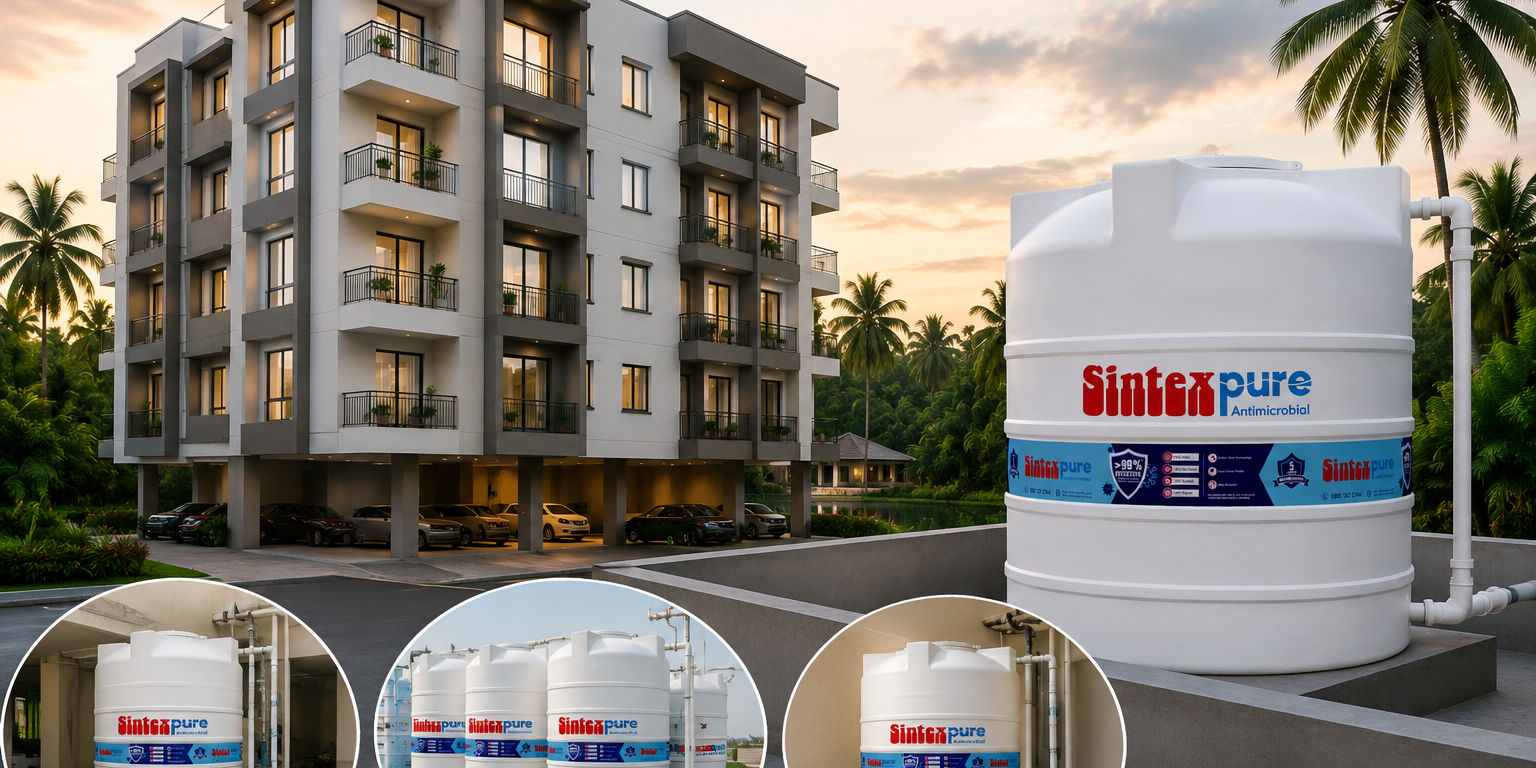
Looking for a water tank for apartments in Kerala? Most of what shows up online is just price lists from dealers in Kochi, Ernakulam, or Kollam, a number and a phone call, nothing else. Nobody tells you how much capacity a 24-unit or 40-unit building actually needs, whether an SMC panel tank makes more sense than several plastic tanks, or how bulk pricing works when you’re buying for a whole project instead of one house.
This guide fills that gap. It’s written for builders, contractors, and apartment associations in Kerala, covering how to size your tank correctly, how to choose between tank types for bulk storage, and what to expect when ordering in bulk the practical information you need before finalising your project’s water storage.
Why Apartment & Commercial Water Storage Is a Different Problem
A homeowner buying a 1,000-2,000 litre tank is solving for one household. A builder specifying water tank capacity for an apartment building is solving for:
- Simultaneous peak demand – every flat drawing water in the same morning and evening window
- Common area consumption – lobby cleaning, landscaping, clubhouse, lift machine room cooling, firefighting reserves (mandatory in many Kerala municipal approvals for buildings above a certain height)
- Dual supply dependency – KWA connection plus borewell, both feeding a shared sump and overhead system
- Long-term association handover – whatever you install becomes the maintenance responsibility of the apartment association for the next 15–20 years
This is why treating an apartment project like “a bigger version of a home tank” leads to under-sizing. The correct approach starts with per-unit demand, not a single flat multiplier
Water Tank Capacity for Apartment Building: The Calculation Builders Actually Need
The Bureau of Indian Standards (IS 1172) sets domestic water demand at 135 to 200 litres per person per day for buildings with full flushing systems, with 135 LPCD used as the baseline for planning multi-storey residential supply. For an apartment complex, the working formula is:
Total daily demand = (Average occupants per flat × Number of flats × LPCD) + Common area allowance
A few notes builders should factor in before finalising numbers:
- Split storage, not one giant tank. Standard practice is an underground sump sized for 1-2 days of total demand, feeding an overhead tank (or tanks) sized for roughly one day’s peak distribution. This is also gentler on rooftop structural load than one oversized tank.
- Add 10-15% for common areas and wastage in addition to the per-person figure, especially where the project includes a swimming pool top-up line, garden irrigation, or a generator/lift cooling circuit.
- Fire reserve requirements, where applicable under Kerala Municipal Building Rules for taller structures, are typically a separate dedicated tank and should not be counted against domestic supply capacity.
- Structural load matters more at this scale. A full 30,000-litre tank weighs over 30 tonnes. Rooftop tank placement needs sign-off from the structural engineer, not just the plumbing consultant, this is one of the most common execution mistakes on mid-sized Kerala apartment projects.
If your project also involves rainwater harvesting as a supplementary source increasingly relevant given Kerala’s seasonal groundwater dips see our guide on choosing the right rainwater harvesting tank for how that storage integrates with your main sump.
SMC Panel Tank vs Plastic Tank for Bulk Storage: Which Should Builders Choose?
This is the decision point most dealer listings skip entirely and it’s the one that affects your project budget and the association’s maintenance costs the most.
Multiple plastic (LLDPE/rotomoulded) tanks
- Lower upfront cost per litre at moderate capacities
- Faster to source and install standard sizes are stocked and delivered quickly
- Simple to replace individually if one unit is damaged
- Beyond a certain volume, you’re managing 4-8 separate tanks with separate plumbing manifolds, which adds interconnection piping, more potential leak points, and more roof footprint
SMC (Sheet Moulding Compound) panel tanks
- Built and assembled on-site panel by panel, so capacity is engineered to your exact space rather than rounded up to the nearest stock size
- A single SMC tank can replace what would otherwise be a battery of plastic tanks, simplifying plumbing to one inlet/outlet system
- Panels are corrosion- and UV-resistant with a longer service life, which matters when the tank becomes association property for two decades
- Higher initial cost than an equivalent volume in standard plastic tanks, but lower long-term maintenance and replacement cost at scale
The right answer depends on your available rooftop or basement footprint, crane/access constraints during installation, and total project budget this is exactly the kind of site-specific call our team works through with builders before finalising a bill of quantities. You can view our full lineup on the Sintex water tank catalogue or talk to us directly about SMC panel options for your project.
How Bulk Water Tank Pricing Works in Kerala
Every listing online or offline shows a single retail price per tank. That’s not how a builder or apartment association should actually be buying.
Here’s what genuinely changes the numbers on a bulk/B2B order:
- Volume-tiered pricing. Ordering 6-10 tanks for one project brings the per-unit rate down meaningfully compared to buying one tank at retail counter price but the discount structure varies by manufacturer and isn’t published anywhere online, because it’s negotiated per order.
- Direct distributor vs. multi-layer dealer pricing. Buying through an authorised distributor who stocks directly from the manufacturer typically removes a margin layer that a smaller retail dealer has to build into their price.
- Delivery consolidation. A single bulk delivery to one site is more cost-efficient than staggered small deliveries relevant when a project is phased across multiple towers or blocks.
- Installation and commissioning bundled in. For apartment projects, the real cost isn’t just the tank it’s crane access for rooftop placement, manifold plumbing across multiple tanks, and testing before handover. A bulk quote should include this, not just the tank price.
- After-sales support at scale. An apartment association will eventually need tank cleaning, leak repair, or float valve servicing factor in whether your supplier offers ongoing servicing and maintenance after handover, since this becomes the association’s problem, not the builder’s, once the project is sold out.
Because bulk pricing genuinely depends on quantity, tank type, delivery location, and installation scope, we don’t publish a generic price list we quote per project after understanding the unit count and site conditions. If you’re at the planning or costing stage, get in touch with our team for a bulk quote tailored to your project.
Choosing the Right Tank Type and Grade for Builder Projects
Beyond capacity and material format, a few specification details matter for commercial and apartment use:
- ISI/ISO certification – non-negotiable for potable water storage in any project that will be inspected or handed over to a resident association. Always confirm certification on the specific model, not just the brand.
- Food-grade, UV-stabilised material – prevents algae growth and material degradation under direct rooftop sun exposure, which is significant in Kerala’s climate.
- Loft and space-saving tank formats – useful where individual flats have private overhead storage in addition to the shared sump system.
- Insulated/PUF options – less critical in Kerala’s climate than in northern India, but relevant for any commercial kitchen or clubhouse application needing temperature-stable storage.
If your project timeline overlaps with active construction curing, dust suppression, worker sanitation you’ll also need interim water storage before the permanent system is commissioned. Our guide on water storage tanks for construction sites covers that separate but related requirement.
Delivery, Installation & Handover for Bulk Orders
For a builder, the tank purchase is only half the job. What actually determines project timeline and post-handover complaints is execution:
- Site access planning – rooftop crane placement needs to be scheduled around other structural work, not as an afterthought
- Manifold plumbing – when multiple tanks are used, interconnection needs a qualified team, not just delivery-and-drop
- Load testing before handover – filling and testing under full load before the tank is signed off to the association
- Documentation for the association – capacity certificates, warranty terms, and a maintenance schedule should be handed over along with the keys
We handle delivery and installation as part of our bulk supply projects across Kerala, so builders get one point of accountability from quote to commissioning rather than coordinating tank supply and installation separately.
Conclusion
Sizing and sourcing a water tank for an apartment complex in Kerala isn’t the same exercise as picking a tank for a home — the per-unit demand calculation, the SMC-vs-plastic decision, and the way bulk pricing actually works all change once you’re planning for 20, 40, or 60 flats instead of one household. Get the sizing table right, choose the tank format that fits your rooftop or basement footprint, and buy from a supplier who quotes bulk pricing transparently and stands behind installation and after-sales service.
Essjay Enterprises has been Kerala’s authorised Sintex water tank distributor since 2001, supplying and installing water storage solutions for residential, commercial, and large construction projects across the state. If you’re a builder, contractor, or apartment association planning your water storage requirement, talk to our team for a capacity assessment and a bulk pricing quote tailored to your project.
How much water tank capacity is needed per apartment unit in Kerala?
As a planning baseline, use 135–150 litres per person per day (per IS 1172 guidelines) multiplied by the average occupancy per flat, then add a 1–2 day storage buffer plus 10–15% for common area use. A typical 2BHK flat with 4 occupants works out to roughly 600–650 litres of daily demand before buffer and common-area additions.
FAQ
How much water tank capacity is needed per apartment unit in Kerala?
As a planning baseline, use 135–150 litres per person per day (per IS 1172 guidelines) multiplied by the average occupancy per flat, then add a 1–2 day storage buffer plus 10–15% for common area use. A typical 2BHK flat with 4 occupants works out to roughly 600–650 litres of daily demand before buffer and common-area additions.
Is an SMC panel tank always better than plastic tanks for a commercial project?
Not always — it depends on scale and space. For moderate bulk requirements (up to roughly 15,000–20,000 litres), multiple manifolded plastic tanks are usually more cost-efficient. Beyond that, or where rooftop/basement space is restricted, a single SMC panel tank engineered to the available footprint typically works out better on both space and long-term maintenance.
Do you offer bulk pricing for builders and apartment associations in Kerala?
Yes. As an authorised Sintex distributor, we quote bulk/B2B pricing based on quantity, tank type, delivery location, and installation scope this is worked out per project rather than published as a flat price list, since it genuinely varies with the order.
Can Essjay Enterprises handle both the underground sump and overhead tank for an apartment project?
Yes, we supply and help specify both underground sump tanks and overhead tank systems as part of the same project, along with the manifold plumbing and installation needed to connect them.
What happens after handover, who maintains the tank for the apartment association?
We offer ongoing tank cleaning, repair, and servicing support after project handover, so the resident association isn’t left without a service point once the builder’s involvement in the project ends.