
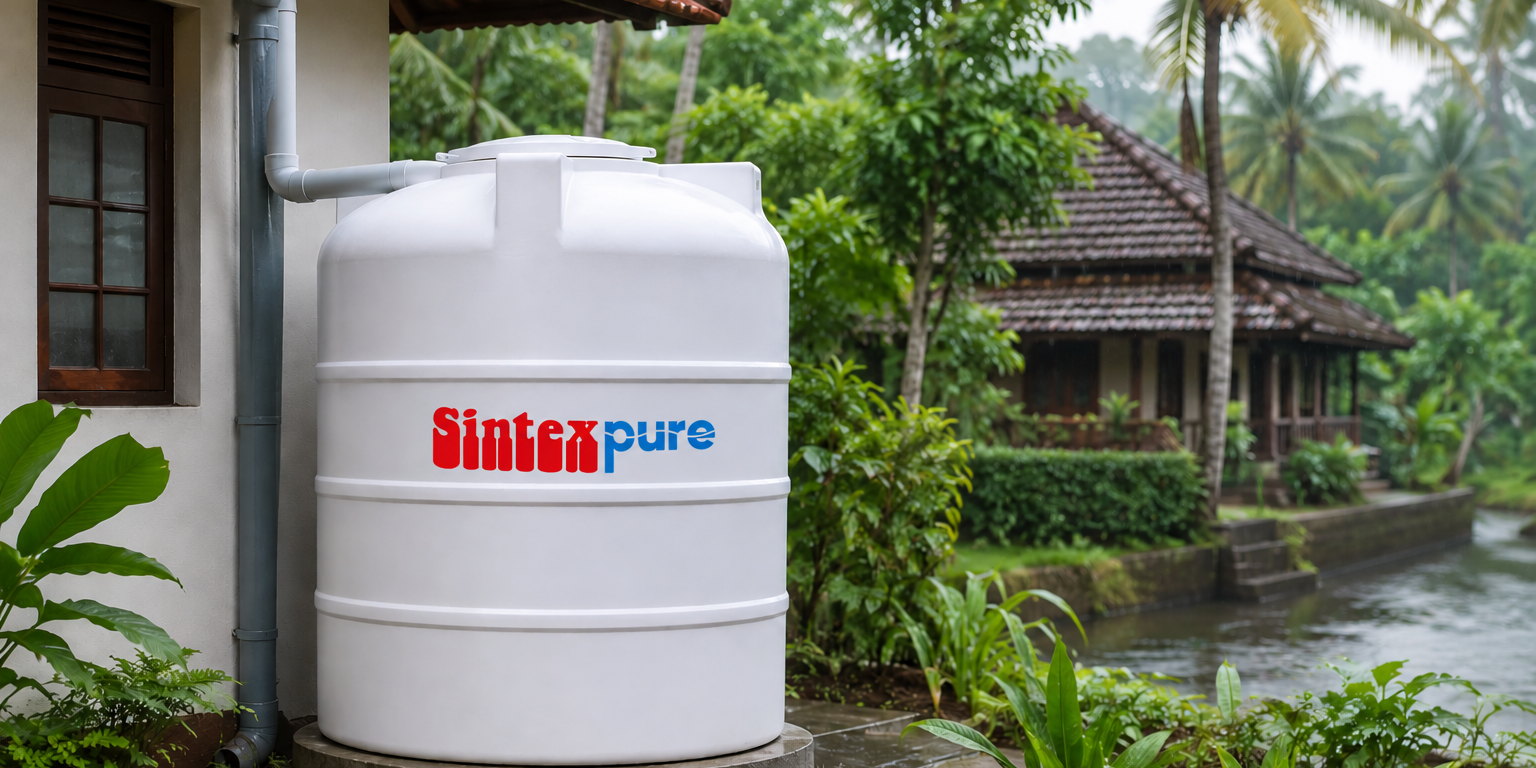
Why Kerala Homes Need a Rainwater Harvesting Tank More Than Ever
Every year, Kerala gets plenty of rain. But by March, the same areas that flooded in June are now struggling to find clean drinking water. Groundwater levels in districts like Kottayam, Pathanamthitta, and Alappuzha have been dropping steadily. Wells run dry. KWA supply becomes irregular. Water bills go up.
The problem is not that Kerala gets too little rain. The problem is that most of that rainwater is wasted. It flows off rooftops and roads and reaches the sea within 48 hours.
A rainwater harvesting tank at your home solves this directly. You collect water during the monsoon and use it in April and May when you need it most. It is that simple.
How a Rooftop Rainwater Harvesting System Works
A rooftop rainwater harvesting system is simpler than most people think. It works in five stages:
Catchment: Your roof surface — tiles, concrete, or sheet — collects falling rain. Every 1,000 square feet of roof area in Kerala can harvest approximately 55,000 to 65,000 litres over a single monsoon season based on the state’s average rainfall data.
Gutters and Pipes: Channels along the roof edge direct water toward a downpipe, which carries it to the next stage.
Filter Unit: The first few minutes of rain wash dust, bird droppings, and debris off the roof. Sand, gravel, and charcoal layers remove remaining particles before water enters storage.
Rainwater Harvesting Tank: This is where everything collected is stored for use — for drinking (with treatment), cooking, cleaning, gardening, and groundwater recharge.
But rooftop collection is not the only way to harvest rainwater. You can also dig a small pit or channel in your compound so that rainwater flows into it naturally and slowly seeps into the ground — recharging your well or borewell. This is called groundwater recharge and it is one of the most effective ways to keep your well full through summer.
This idea is actually not new. Kerala’s farmers have been doing a version of this for generations. They used to build small mud bunds, simple soil barriers, across their fields and slopes to slow down rainwater flow and hold it
The statement “two main types” is partially correct but incomplete. Here is the fact check result and the corrected version:
Types of Rain Water Harvesting Tanks — Which One Is Right for You?
Rain water harvesting tanks are not one-size-fits-all. Depending on your home, your land, and what you want to achieve, there are three main types to consider:
Overhead or Rooftop Tanks: Placed on an elevated platform or terrace. Water flows down to your taps by gravity, so no pump is needed for daily use. Easy to inspect and clean. Since they sit in the open, UV protection and an antimicrobial inner lining are very important — especially in Kerala’s post-monsoon heat.
Underground Sump Tanks: Installed below ground level and connected directly to your harvesting setup. Protected from sunlight and heat, which keeps water cleaner for longer. Ideal for storing large seasonal volumes — 10,000 litres and above. Water is pumped up for use. Best choice if your goal is to store an entire monsoon season’s worth of water for use through summer.
Loft Tanks: Smaller tanks installed inside the building, typically below the terrace slab. They take up no rooftop space and are protected from weather. Sintex offers compact loft tank options that work well for apartments and smaller homes in Kerala where terrace space is limited.
Recharge or Percolation Tanks: These are not storage tanks in the traditional sense. Instead of holding water for direct use, they are designed to direct harvested rainwater back into the ground — recharging your well or borewell. This is exactly what Kerala’s Mazhapolima scheme promotes across Thrissur, Kottayam, and other districts. If your well runs dry every summer, a recharge tank alongside your storage tank is the most effective long-term solution.
This means a single 1,000-litre overhead tank is not enough for seasonal water security. Most Kerala homes benefit from combining an overhead tank for daily use with an underground sump or a recharge pit for seasonal storage and well recharge.
What Makes Sintex the Best Rainwater Harvesting Tank for Kerala’s Climate
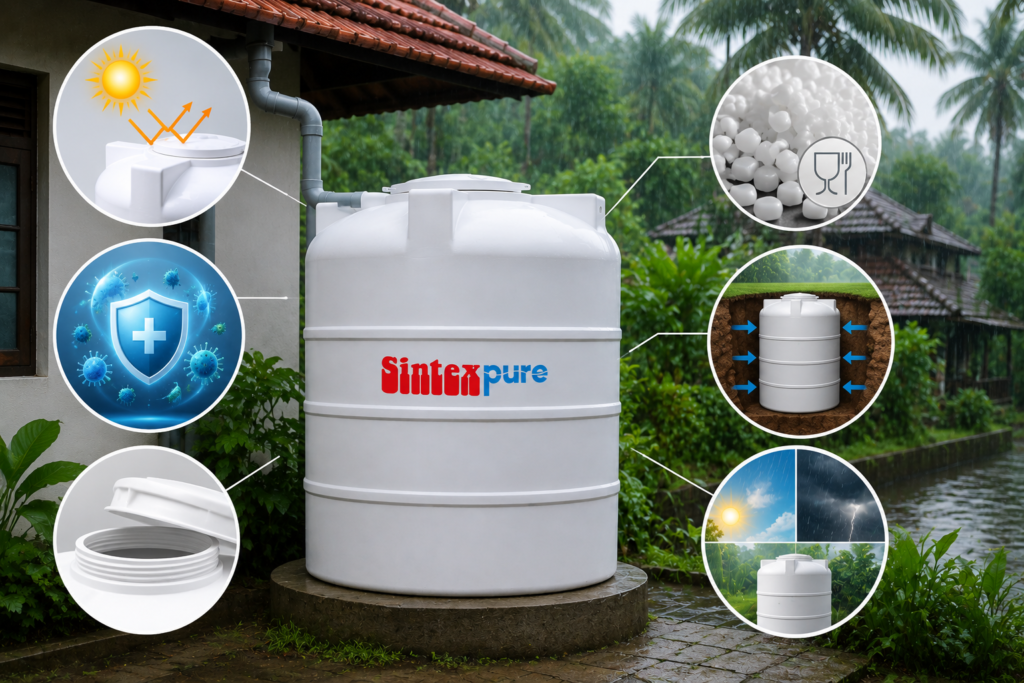
Not all rainwater harvesting tanks are built to handle Kerala’s conditions. The combination of heavy monsoon rainfall, high humidity, intense post-monsoon heat, and occasional flood-level waterlogging demands a tank that is engineered specifically for these stresses.
Sintex water tanks from Essjay Enterprises meet every one of these demands:
UV Stabilised Body: Sintex tanks are built with UV-stabilised material that prevents the plastic from degrading under direct sunlight. This matters especially for overhead tanks exposed to Kerala’s post-monsoon sun.
Antimicrobial Protection (Pure Plus):Sintex Pure Plus tanks, available at Essjay Enterprises, use Active Silver Technology — silver ions infused directly into the tank material — delivering 99% effectiveness against bacteria, viruses, fungi, and algae, verified under four international standards: ISO 21702:2019, JIS Z 2801:2010, ASTM G29, and ASTM G21:2015. Built with FDA-approved, 100% food-grade virgin plastic and a UV-stabilised body, every drop stored stays protected from the moment it enters the tank. For Kerala homes storing rainwater through summer, this is not optional — it is essential.
Sealed Threaded Lid: Monsoon winds carry leaves, insects, and debris. Sintex’s threaded lids create a tight seal that keeps flood runoff, mosquitoes, and contaminants from entering your stored water.
Food-Grade Virgin Plastic: Every Sintex tank uses 100% food-grade, BPA-free plastic. There is no chemical leaching into your harvested rainwater.
Multi-Ribbed Structural Body: The ribbed construction gives Sintex tanks structural integrity under external pressure — critical for underground sump installations where soil and water pressure act on the tank walls throughout the monsoon.
When you choose a Sintex rainwater harvesting tank from Essjay Enterprises, you are not just buying storage — you are buying water safety through every season.
Government-Sponsored Schemes for Rainwater Harvesting in Kerala
This is information most tank suppliers in Kerala never share with their customers — and it can save you significant money.
Kerala Building Rules (KBR): Under current Kerala Building Rules, all new residential and commercial buildings above a specified plinth area are required to incorporate rooftop rainwater harvesting systems as a condition of building permit approval. Installing a certified tank is part of legal compliance for new construction across Kerala.
Jalanidhi Scheme: Funded jointly by the Kerala government and the World Bank, Jalanidhi supports rural water supply and sanitation including community-level rainwater harvesting infrastructure. Local bodies in eligible areas can access funding that reduces individual household costs significantly.
Mazhapolima Programme: This is a Kerala Water Authority initiative specifically designed to promote rooftop rainwater harvesting in rural areas. Under Mazhapolima, eligible households receive technical support and partial financial assistance for setting up a complete rooftop rainwater harvesting system including storage tanks. Kottayam district has been one of the active implementation zones for this programme.
KSEB and Panchayat-Level Schemes: Several grama panchayats across Kerala have tied rainwater harvesting tank installation to their local development fund allocations, particularly in flood-prone and water-scarce wards.
Common Mistakes Kerala Homeowners Make with Rainwater Harvesting Tanks
Understanding what goes wrong is as important as knowing what to do right.
Buying an undersized tank: A 500-litre or 1,000-litre tank cannot serve as seasonal storage. If your goal is water security through summer, your rainwater harvesting tank must hold a minimum of 5,000 to 10,000 litres.
No overflow connection: During heavy Kerala downpours, tanks fill fast. Without a proper overflow outlet, water backs up, floods the system, and can damage the tank structure or the building.
Ignoring tank placement: Overhead tanks placed in full sun without UV protection degrade faster and allow algae growth. Always choose a UV-stabilised rainwater harvesting tank for exposed positions.
Not sealing before monsoon: Open or cracked lids are an open invitation for mosquito breeding and flood debris. Check and tighten all lids and inlet covers before June every year.
Skipping pre-monsoon cleaning: Any sediment or stale water left from the previous year should be fully flushed before the new harvesting season begins.
Start Harvesting Rain Before the Next Monsoon Hits
Kerala’s monsoon is predictable. The water scarcity that follows it is also predictable. What does not have to be predictable is your family running short of water every summer while last June’s rainfall flowed unused into the sea.
A properly installed rainwater harvesting tank is not an expense — it is an investment that pays back every summer when your neighbours are struggling with water scarcity and you are not. With Kerala government schemes like Mazhapolima and Jalanidhi reducing setup costs, and Sintex’s ISO-certified tanks ensuring long-term reliability, there has never been a better time to set up your system.
Essjay Enterprises has supplied and installed Sintex rainwater harvesting tanks across Kerala for over 25 years, serving homes, farms, factories, and government projects. We are based in Kottayam and deliver across the entire state.
Contact Essjay Enterprises today to find the right rainwater harvesting tank for your home — before the next monsoon arrives.
Frequently Asked Questions (FAQs)
What size rainwater harvesting tank do I need for my Kerala home?
For a family of five in Kerala, the Kerala Water Authority VARSHA programme data recommends a minimum of 5,000 litres for drinking and cooking needs through summer. For full household use, washing, cleaning, and gardening included, Kerala State Water Policy research recommends 10,000 to 15,000 litres of total storage. A single 1,000-litre tank is not sufficient for seasonal water security. Most Kerala homes benefit from combining an overhead tank for daily use with an underground sump for seasonal storage.
Can I drink water stored in a rainwater harvesting tank?
Yes, but with proper treatment. Rainwater collected from rooftops passes through a filter unit before entering the tank, which removes most physical impurities. For drinking and cooking, the stored water should be further treated, boiled, UV filtered, or run through a purifier. Sintex Pure Plus tanks with Active Silver Technology significantly reduce bacterial and microbial growth during storage, making the water safer before final treatment.
Is rainwater harvesting compulsory for new homes in Kerala?
Yes. Under the Kerala Municipality Building Rules, all new residential buildings with a floor area of 100 sq m or more and a plot area of 200 sq m or more are required to install a rooftop rainwater harvesting system as part of the building permit process. Commercial, educational, and industrial buildings also fall under this mandate. Installing a certified tank is part of legal compliance for new construction across Kerala.
What is the difference between an overhead tank and an underground sump for rainwater harvesting?
An overhead or rooftop tank sits on an elevated platform and supplies water by gravity — no pump needed for daily use. It is easier to clean and inspect but is exposed to sunlight and heat, so UV protection is essential. An underground sump tank is installed below ground, stays cool, and is ideal for storing large seasonal volumes of 10,000 litres and above. Water is pumped up for use. For maximum water security in Kerala, many homes use both — overhead for daily use and underground for seasonal storage.


1 Comment