If your tap water has started smelling odd, tastes slightly off, or leaves a film in your glass, the first suspect isn’t your pipes – it’s your tank. For most Kerala homes, that overhead tank sits quietly on the terrace for months, doing its job, until sediment, algae, and bacteria build up enough to become a real health concern.
So how often should you actually clean it? Here’s a straight answer, backed by what health authorities recommend, along with the signs that tell you it’s time – and the signs that tell you it’s time to stop cleaning and start replacing.
How Often Should You Clean Your Water Tank?
For a typical Kerala household, every 3 to 6 months is the standard recommendation for overhead tank cleaning. This aligns with WHO guidance on water storage hygiene, and it’s the frequency most professional cleaning services in the state work to as a default schedule.
That said, “every 3-6 months” isn’t a one-size-fits-all number. Your actual frequency depends on a few local factors:
- Water source – Corporation/municipal water with more inconsistent treatment quality may need more frequent cleaning than a well-fed sump with a reliable filtration setup.
- Monsoon exposure – Kerala’s monsoon months bring silt, debris, and unpredictable water quality through municipal lines and open wells alike. A post-monsoon clean (typically post-June and post-October) is worth adding even if you’re on a 6-month cycle.
- Tank material and age – Older concrete or ferro-cement tanks tend to harbor more algae growth in surface pores than a smooth-walled triple-layer plastic tank. If yours is a rougher-surfaced or aging tank, lean toward the 3-month end of the range.
- Sediment load – If your last cleaning revealed a thick layer of sludge at the base, that’s a signal your tank needs quarterly attention, not half-yearly.
- Household size – Higher usage households cycle water faster, which can actually reduce standing time for algae – but also means faster refill after any contamination event, so don’t stretch the interval based on usage alone.
Underground sumps typically need attention on a similar or slightly less frequent cycle than overhead tanks, but should always get a check after heavy monsoon flooding, since surface water intrusion is a real risk for sumps in low-lying areas.
Signs Your Water Tank Needs Cleaning Now
Don’t wait for the calendar if you notice any of these:
- Visible discoloration – brown, yellow, or greenish tint to stored water
- Odour – a musty, earthy, or rotten-egg smell from tap water
- Sediment or grit – gritty residue at the bottom of a glass of water, or visible sludge when you open the tank lid
- Slimy tank walls – a biofilm layer you can feel when you touch the inside walls, usually algae or bacterial growth
- Reduced water pressure – sediment can partially clog outlet pipes and float valves
- Insects or debris inside the tank – a sign the lid seal has failed and contaminants are entering
- Family members experiencing recurring stomach upset – while this has many causes, contaminated stored water is worth ruling out
If two or more of these apply, don’t wait for your next scheduled cleaning – book one now.
What a Standard Cleaning Actually Involves
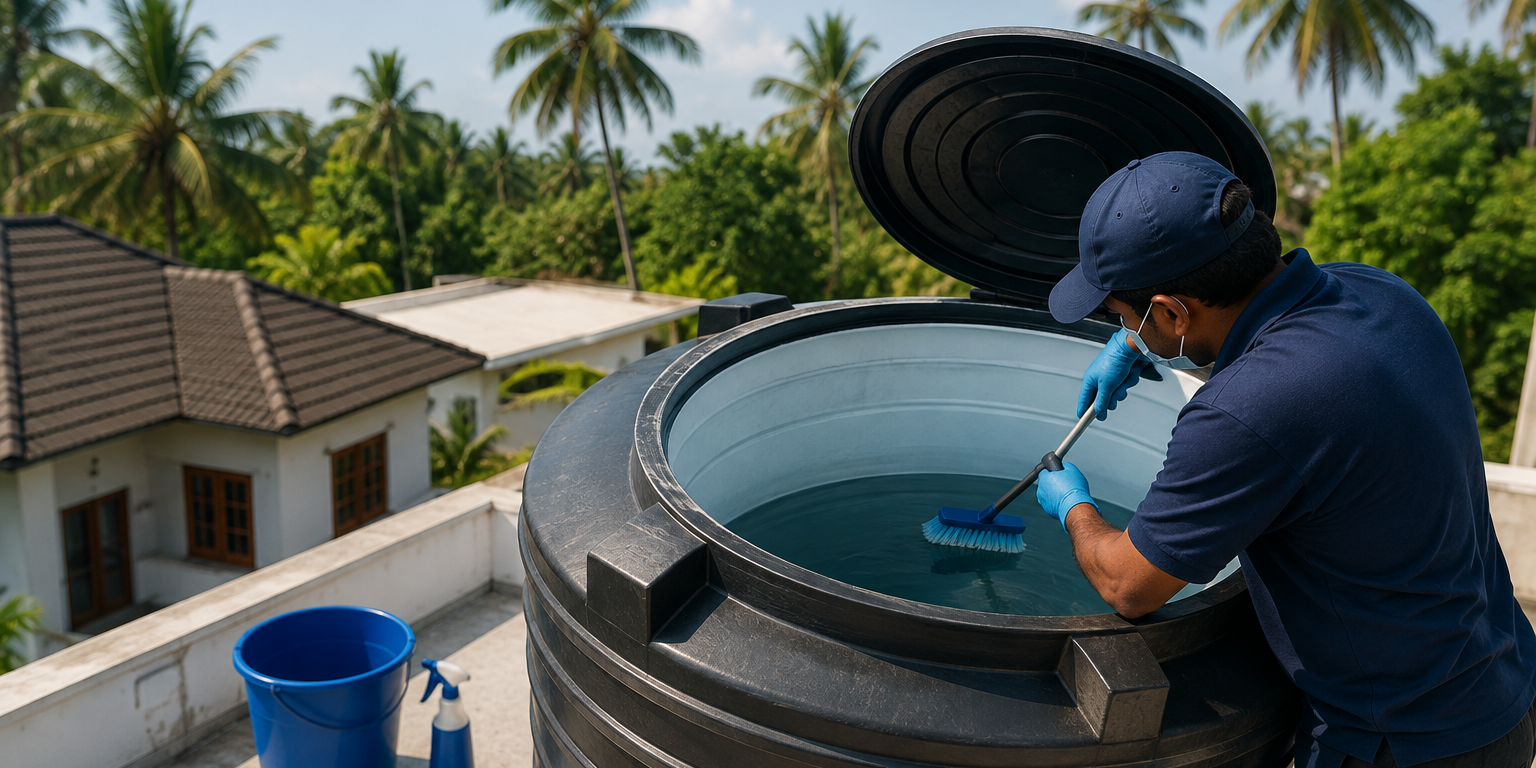
A professional overhead tank cleaning typically follows this process:
- Draining – the tank is emptied completely
- Sediment removal – accumulated sludge and debris at the base is manually or mechanically removed
- Scrubbing – interior walls, floor, and lid are scrubbed to remove biofilm and mineral deposits
- Disinfection – a food-grade chlorine or approved disinfectant solution treats the interior
- Rinsing and refilling – the tank is rinsed to clear disinfectant residue, then refilled
For a standard 500-1000 litre overhead tank, this process usually takes 1-2 hours. Larger underground sumps can take longer.
Water Tank Cleaning Cost in Kerala – What to Expect
Cleaning rates vary by provider, tank size, accessibility, and contamination level – treat the figures below as a rough starting point, not a quote. Always confirm current pricing directly with your service provider before booking.
Expect the price to move up if:
- The tank is on an upper floor with poor access (no lift, narrow stairwell)
- It’s been years since the last cleaning and sludge has hardened
- You have multiple smaller tanks instead of one large one (more setup time per tank)
- It’s an underground sump requiring confined-space entry and extra safety equipment
When to Clean vs. When to Replace
This is the question most cleaning-only services can’t really answer for you – because they don’t sell tanks. But it matters just as much as the cleaning schedule itself.
A cleaning restores hygiene. It does not fix:
- Cracks or leaks in the tank body
- UV-degraded plastic that’s gone brittle or chalky on the outer surface
- Persistent discoloration that returns within weeks of every cleaning (often a sign the tank material itself is degrading and leaching into stored water)
- A failed or missing lid seal that keeps letting in dust, insects, or rainwater regardless of how often you clean
- A tank that’s simply undersized for your household’s current usage, forcing more frequent refill cycles and less settling time for sediment
If your tank is 10-15+ years old, made from a lower-grade single or double-layer plastic, and needs cleaning more frequently than every 3 months just to stay usable, you’re likely paying for cleaning to manage a problem that only a tank replacement will actually solve. Modern triple-layer and antimicrobial tank options are specifically designed to resist algae growth and bacterial buildup between cleanings – meaning fewer service call-outs and safer water in between them.
This is where it helps to talk to someone who handles both sides – tank supply and post-installation servicing – rather than a pure cleaning outfit that has no reason to tell you when the tank itself is the problem.
Essjay Enterprises supplies and services Sintex tanks across Kerala, and can advise honestly on whether your existing tank just needs a clean or has reached the point where replacement is the more cost-effective call. Get in touch at essjayenterprises.com for a straightforward assessment.