If you’ve searched for a water tank in Kerala recently, you’ve probably heard “Sintex” used almost like a generic term — the way people say “Xerox” for photocopies. That’s exactly the problem. A genuine Sintex tank is so trusted that it’s also the most imitated product on the market.
Walk into any hardware market in Kochi, Kottayam, or Thrissur and you’ll find tanks that look like Sintex. They’re priced like a bargain and sold with a wink as “same quality, cheaper price.” They’re not the same. In Kerala’s climate — punishing summer UV followed by months of relentless monsoon — the gap between a genuine Sintex tank and a duplicate isn’t cosmetic. It shows up as cracked walls, algae-green water, and a tank that needs replacing in 3 years instead of lasting 15 to 50.
This guide walks you through exactly how to identify a genuine Sintex tank, point by point, before you hand over your money.
Why a Genuine Sintex Tank Matters More in Kerala
Kerala’s tanks don’t get an easy life. They sit on rooftops through 8–12 hours of direct sun for months, then face sustained monsoon pressure and moisture for weeks at a stretch.
A tank without genuine UV stabilisation and proper multi-layer construction degrades far faster here than in drier states. That’s precisely why duplicate and unbranded “local” tanks — often missing the UV layer or made from reprocessed plastic — tend to fail early in Kerala. Expect brittleness, discolouration, algae growth, and, in worse cases, chemicals leaching into stored drinking water.
In short, a genuine tank isn’t just a brand name. It’s a real difference in how your household’s water is stored and protected.
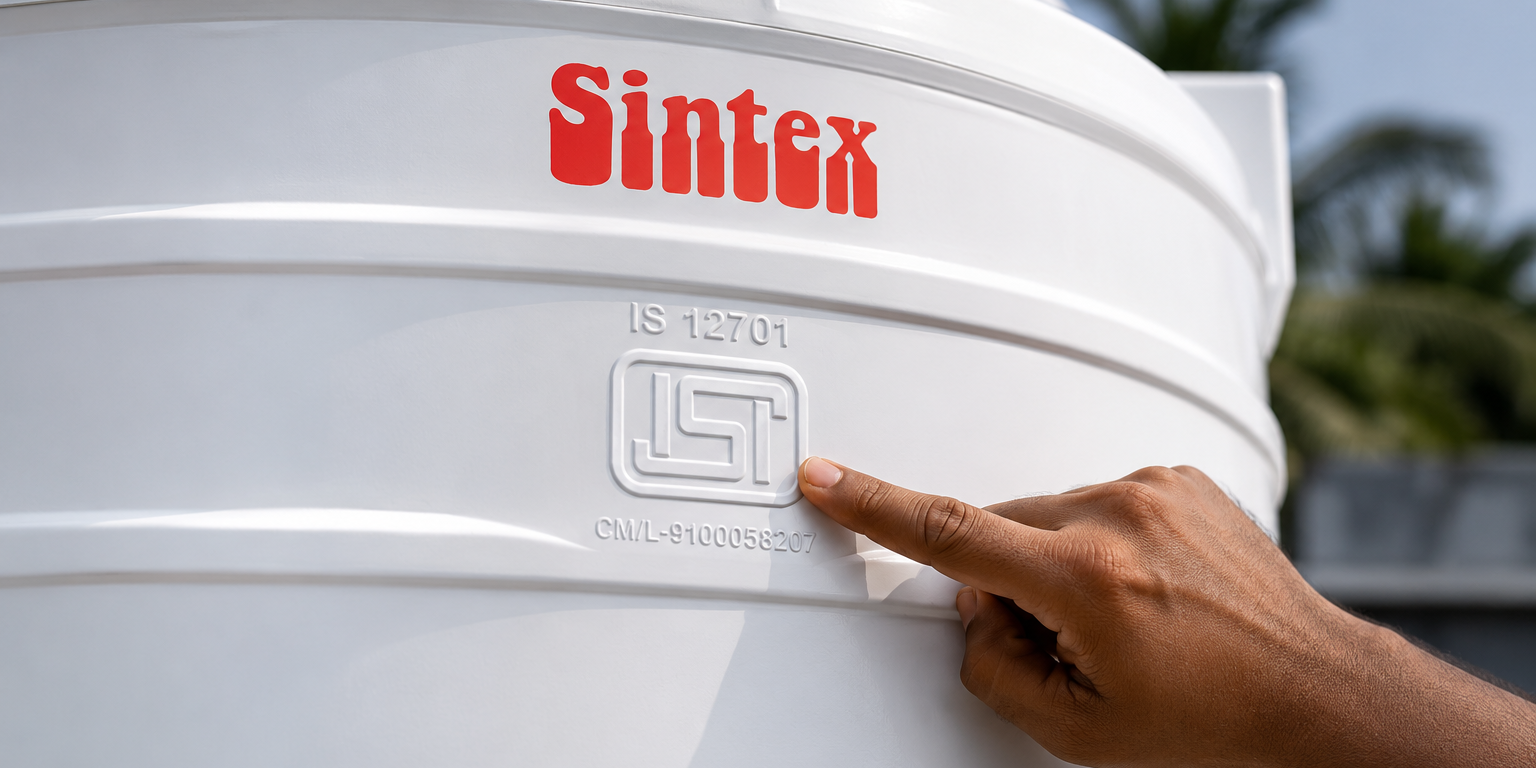
1. Check for the ISI/BIS Mark (IS 12701)
The single most important physical marker on a genuine Sintex tank is compliance with IS 12701, the Bureau of Indian Standards specification for polyethylene water storage tanks. This certification confirms the tank has been tested for:
- Food-grade material safety (no harmful chemical leaching)
- Wall thickness and structural strength
- UV resistance
- Dimensional accuracy
Manufacturers mould this mark into the plastic itself on a genuine tank — never print it on a loose sticker that can be peeled off and reused on any tank. If a seller can’t show you where this mark is physically embossed on the tank body, treat that as your first red flag.
2. Genuine Sintex Tank Branding: Moulded vs Stuck-On
Manufacturers emboss the brand name directly into a genuine Sintex tank during the rotational moulding process. Run your finger over it — it should have texture, not sit flush like a printed sticker.
Duplicates commonly get this wrong in one of two ways:
- A sticker-based logo that’s glossy, flat, and can be scratched off
- Font, spacing, or logo placement that’s slightly “off” compared to an official tank
If you’ve seen a genuine Sintex tank before, a side-by-side comparison makes this obvious almost immediately.
![Close-up comparison of moulded versus stickered tank branding — alt text: “genuine Sintex tank branding versus duplicate sticker logo”]
3. Check the Layer Construction
Authentic Sintex tanks — Hero, Titus, Pure, Pure Plus, and others — use genuine double or triple-layer construction:
- Outer layer — coloured (white, blue, yellow, or green), aesthetic and weather-facing
- Middle layer — black, UV-blocking
- Inner layer — food-grade virgin plastic in contact with water
You can usually spot this layering at the manhole rim or lid edge. A genuine Sintex tank shows a distinct black band sandwiched between the outer and inner colours. Cheap duplicates, on the other hand, are frequently single-layer tanks with an outer coat of paint made to look multi-layered. Painted-on colour simply doesn’t block UV the way a genuine moulded black layer does.
4. Run the Material and Weight Test
Manufacturers make a genuine Sintex tank from 100% virgin food-grade polyethylene, never recycled or reprocessed plastic. A few practical checks:
- Feel and smell. Reprocessed plastic often has a duller, uneven colour and a faint chemical odour. Virgin plastic feels smoother and more uniform.
- Weight. For the same capacity, a genuine tank with proper wall thickness weighs noticeably more than a thin-walled duplicate. If a “1000-litre Sintex” feels unusually light, be suspicious.
- Wall thickness. Run your hand along the base, mid-body, and rim. A genuine tank maintains even thickness throughout, while duplicates often go thin at the base or top rim — exactly the points under the most structural stress.
5. Ask About UV Stabilisation on Both Tank and Lid
Here’s a detail many buyers miss: a genuine Sintex tank is UV-stabilised on both the tank body and the lid. Duplicate manufacturers frequently skip UV treatment on the lid to save cost, since it’s the less visible part.
As a result, an untreated lid lets in enough UV over time to trigger algae growth inside the tank, even if the tank body itself is fine. That single shortcut defeats the entire purpose of buying a quality tank.
6. Verify the Warranty Card and Registration
A genuine Sintex tank comes with:
- A physical warranty card
- A batch or serial number specific to that tank
- Coverage ranging from 5 years (Reno) up to 50 years (Eterno), depending on the model
To actually use this warranty, you need to keep your purchase invoice safe and register the product through Sintex’s official channels, submitting your product and batch details as proof. No warranty card, no serial number, no way to register — that means no real warranty, no matter what a seller promises verbally.
Sintex’s own policy is clear on this: a proof of purchase is mandatory for any claim, so an invoice isn’t optional paperwork — it’s your entire claim eligibility. (See our Sintex Water Tank Price List 2026 for warranty coverage by model.)
7. Insist on a Proper Invoice — Not Just a Cash Receipt
This is the step most buyers skip, and it’s the one that costs them the most later. A proper GST invoice from an authorised dealer does three things:
- Serves as your only real proof of purchase for warranty claims
- Confirms you bought a genuine, billed product — not a duplicate sold under the table
- Protects you if the tank develops a manufacturing defect years down the line
If a seller offers a “discount” for cash with no bill, or hesitates to give a proper invoice, that hesitation alone tells you something about what you’re actually buying.
8. Buy Your Genuine Sintex Tank Only From an Authorised Kerala Distributor
The most reliable way to avoid all of the above guesswork is to buy from a dealer inside Sintex’s official distribution network — not a general hardware shop stocking an unverified “Sintex-type” tank.
Essjay Enterprises has distributed genuine Sintex water tanks across Kerala for over 25 years, supplying a network of 100+ dealers statewide. Buying through an established, authorised distributor means the branding, ISI certification, layer construction, and warranty documentation are all exactly as they should be, with no guesswork on your end. We also handle tank delivery and installation across Kerala once you’ve made your choice.
9. Watch the Price — If It’s Too Good, It’s Probably Not a Genuine Sintex Tank
Genuine Sintex tanks are priced within a fairly narrow, predictable range depending on model and capacity. Entry-level tanks like Sintex Neo start lower, while antimicrobial and extended-warranty ranges like Pure Plus or Eterno cost more.
If a “Sintex” tank is offered 30–40% below the typical authorised-dealer price for that size, treat it as a warning sign, not a bargain. Manufacturing to IS 12701 standards, using virgin plastic, and building in genuine UV layers all cost money — an unusually cheap price usually means one or more of those has been cut. Our current price list is a useful benchmark if you want to sanity-check a quote.
Conclusion
A genuine Sintex tank isn’t just a name. It’s the difference between clean, safe water for the next 15–50 years and a duplicate that turns brittle, discoloured, and unsafe within a few monsoons.
Before you buy, check the moulded ISI mark, look closely at the branding and layer construction, ask for the warranty card, and always insist on a proper invoice. When in doubt, the simplest safeguard is buying from an authorised distributor rather than an unverified hardware shop.
Essjay Enterprises has been Kerala’s authorised Sintex distributor for over 25 years, supplying genuine, ISI-certified tanks through a statewide network of 100+ dealers. If you want to be sure you’re getting a genuine Sintex tank, get in touch with our team before you buy.