Introduction
You spotted a wet patch on the wall below your tank, or maybe water is trickling down the side every time it fills. Your first instinct is to search for a water tank leakage solution, and you land on a dozen articles telling you the same thing: drill two holes at the ends of the crack, clean the surface, apply epoxy or run a plastic welding rod along the line, let it cure.
That advice isn’t wrong. It’s also not the question you’re actually asking.
The real question, whether you’re fixing water tank leak damage for the first time or the third, is: is this crack worth fixing, or is your tank on its way out? A DIY patch that holds for two months on a tank that’s already brittle from UV exposure isn’t a solution, it’s a delay. Before you reach for the epoxy, here’s how to actually decide.
Why Every “Fix a Cracked Water Tank” Guide Skips the Important Part
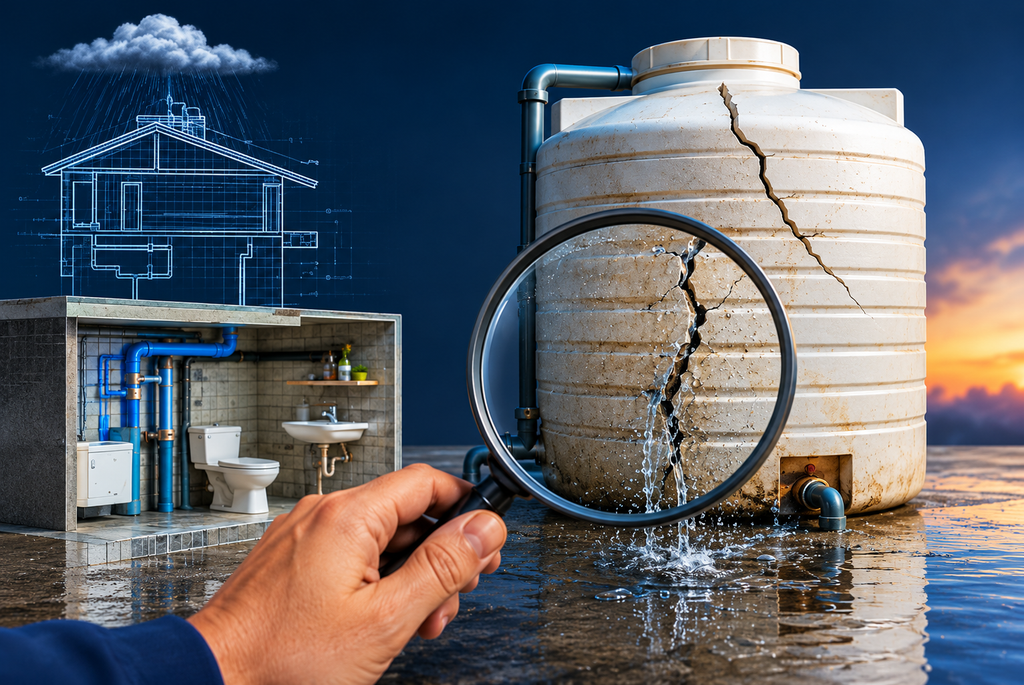
Search for plastic water tank crack repair and you’ll mostly find manufacturer blogs and portal listicles. They’re written to be generic, because they’re written for a national audience. None of them ask how old your tank is, where exactly the crack is, or whether the plastic around it is still flexible. They can’t ,they don’t know your tank.
Search for water tank repair service Kerala and it gets worse: mostly directory listings, nobody explaining what’s actually going on with your tank or what your options are.
If your tank size itself is part of the problem ,constant overflow, running dry between fills ,that’s a different issue worth sorting out separately; see our guide on how to calculate the right water tank size for your home. But if it’s leaking, here’s how to actually diagnose and decide.
Step 1: Where Is the Crack?
Location tells you almost everything.
- Near the top rim or lid area – usually caused by UV degradation, sun exposure, or someone over-tightening the lid. Often a clean, repairable crack if the plastic isn’t chalky or flaking.
- Along a horizontal ring/weld line – these are the manufacturing seams. A crack that follows this seam usually means the weld itself has failed, not just the surface. Repairs here are less reliable and tend to reopen under water pressure.
- Near the base or bottom third – this is the highest-pressure zone of the tank. A crack here, especially a hairline crack that’s grown, is a strong signal the plastic has gone brittle throughout, not just at that one spot. This is where a broken water tank often started life as a “small, repairable” one.
- At an inlet/outlet fitting – often not a tank problem at all, but a loose or perished rubber gasket. This is the cheapest and most reliable fix of all, and it’s frequently misdiagnosed as leakage from a water tank.
Step 2: Surface Damage or Layer Damage?
Most tanks ,including genuine Sintex tanks ,are built in three layers: a UV-resistant outer layer, a food-grade inner layer, and a middle structural layer. This matters more than most guides mention.
- Surface-only crack: hasn’t gone past the outer layer. Feels smooth to the touch, no flaking, no visible white or chalky patch. These respond well to a water tank leakage treatment like epoxy or plastic-weld repair and can hold for years.
- Full-layer crack: you can see or feel through to the structural layer, there’s flaking or a powdery texture around the crack, or the plastic feels thinner when pressed. Epoxy here is cosmetic – it stops the drip today, not the failure. Water pressure and thermal expansion (Kerala’s heat-to-rain cycles are brutal on plastic tanks) will usually reopen it or crack an adjacent spot within a season.
If you’re not sure which one you’re looking at, that’s genuinely the most useful thing a technician visit tells you, it’s a two-minute inspection, not a guess.
Step 3: How Old Is the Tank?
Rough guide for roto-molded plastic tanks under normal Kerala sun exposure:
| Tank age | What it usually means |
| Under 5 years | Repair almost always makes sense, assuming surface-level damage |
| 5–10 years | Depends heavily on damage type and how much direct sun the tank gets |
| 10+ years, or visibly chalky/faded exterior | Replacement is usually the better economics – the plastic has lost flexibility across the whole tank, not just at the crack |
A tank that’s gone visibly pale or chalky compared to its original colour has UV-degraded plastic overall. One crack there is rarely the only weak point – it’s just the first one that gave way. Curious what a fresh tank actually costs before you decide? Browse the current Sintex water tank catalogue for pricing and capacities.
Step 4: Check the Warranty Before You Do Anything
If your tank is a genuine still within its warranty window (typically 5–10 years depending on the model), a manufacturing defect ,like a seam failure or a crack with no obvious external cause ,may be covered. This is worth ten minutes before you spend money on repair or replacement. Damage from external causes (a fall, impact, someone standing on the lid) usually isn’t covered, but it costs nothing to check.
Note: All warranties and guarantees are subject to the terms and conditions laid out by Welspun BAPL Ltd (operating the Sintex brand). All claims and terms of replacement are subject to the company’s policies. Please check the official Sintex website for full details.
Repair vs. Replace: The Honest Cost Comparison
| Repair (epoxy/weld) | Replacement | |
| Typical cost | Low – mostly labour, minimal material | Tank cost + installation + disposal of old tank |
| Time | Same day | 1- 3 days depending on tank size/availability |
| Lifespan of fix | Months to a few years, depending on crack type and tank age | Full tank life (10+ years) |
| Best for | Younger tanks, surface-level cracks, fitting/gasket leaks | Tanks 10+ years old, layer damage, repeated leaks, visibly degraded plastic |
| Risk | Reopens or a new crack appears elsewhere on an aging tank | None – you’re starting the clock over |
The uncomfortable truth the DIY guides won’t tell you: if your tank is old and the plastic is brittle, a repair is money spent to buy a few more months, not a real fix. If it’s a younger tank with a clean, surface-level crack, replacing it is money you didn’t need to spend.
When to Just Call Someone
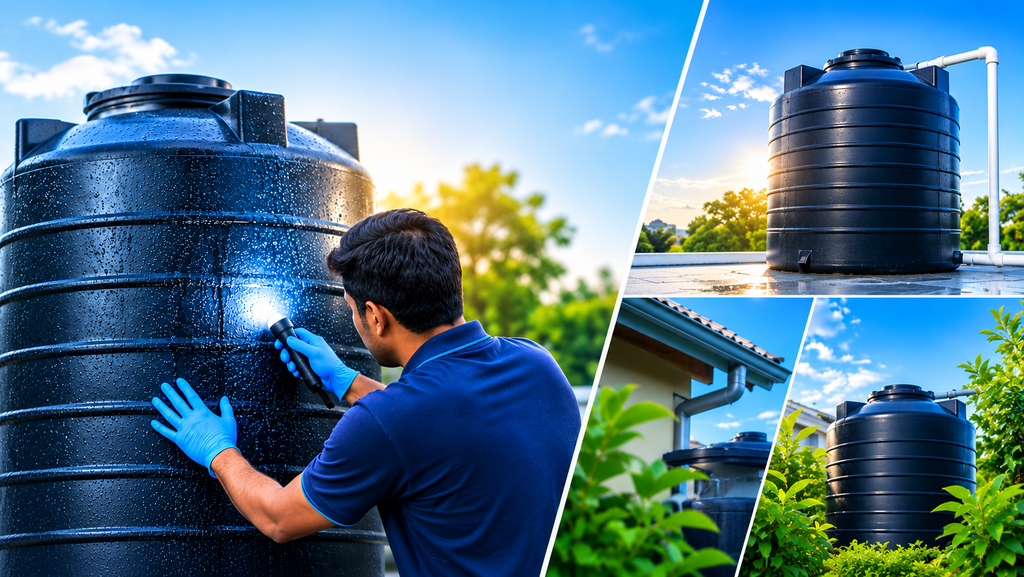
If you’ve checked the crack location, can’t tell surface damage from layer damage, or the tank is old enough that you’re not sure it’s worth fixing, that’s exactly the situation a quick inspection settles in minutes instead of guesswork. Our water tank repair and servicing team covers this and we’ll tell you honestly if a repair will hold or if you’d be better off replacing not just sell you whichever is easier for us. If replacement turns out to be the right call, our delivery and installation service has you covered end to end, and if it’s a fresh rainwater setup you’re after, see our guide on choosing the right rainwater harvesting tank.
FAQ
What’s the best water tank leakage solution for a small crack I can see clearly?
If the crack is surface-level (smooth edges, no flaking, no visible layer underneath) and the tank is under 5 years old, an epoxy or plastic-weld repair is usually enough. If you’re unsure whether it’s surface or full-layer damage, get it inspected before applying anything ,treating a deep crack like a surface one is the most common reason repairs fail again within weeks.
How do I know if I’m just fixing a water tank leak temporarily or actually solving it?
Check where the crack sits. Cracks along weld seams or near the base, on tanks showing chalky or faded plastic, tend to reopen even after a “successful” repair ,because the surrounding plastic is degrading too, not just the one spot you patched.
Is plastic water tank crack repair safe for drinking water tanks?
Only if you use a food-grade epoxy or sealant rated for potable water contact ,general-purpose plastic repair products aren’t. This is one area where a professional repair service matters, since the wrong sealant can contaminate stored water even after the leak stops.
My Sintex tank is leaking; is it covered under warranty?
It depends on the tank’s age, model, and cause of the crack. Manufacturing defects (seam failures, unexplained cracks) within the warranty period are often covered; damage from impact, falls, or misuse usually isn’t. All warranty and guarantee claims are subject to the terms and conditions of Welspun BAPL Ltd (Sintex). Please refer to the official Sintex website for current policy details. It costs nothing to check before paying for repair or replacement.
How much does water tank repair service in Kerala typically cost compared to replacing the tank?
Repair is almost always cheaper upfront ,it’s largely a labour cost with minimal material. But on a tank older than 10 years or with layer damage, repeated repairs can add up to more than the tank was worth saving. A quick inspection will usually tell you which side of that line your tank falls on.